Agency Automate
Joining a Three-Person Team and Learning to Own the Stack
Two years as a founding engineer at a Minnesota-based software company, growing from front-end focused to full-stack under the guidance of people who bet on potential over credentials.
 Ian Gabriel Agujitas


March 2024. The team at Agency Automate was three people. Rob, the founder, was running the company out of Minnesota, and the product they were building was real and already had clients. There was no big onboarding, no lengthy ramp-up. I was one of three founding engineers, and the work was real from day one.
Rob took a chance on bringing me in even though I was not strong on the back end at the time. That was clear from the start, and it was not something that got glossed over. He knew it, I knew it, and he still made the call. That kind of trust is not something you forget. It set the tone for everything that followed.
The early months were about figuring out how to contribute meaningfully while catching up on the parts of the stack I was still unfamiliar with. The front end came naturally: Angular, TypeScript, building interfaces that connected cleanly to the back end. But Laravel was new territory. The back end side of things required a different kind of thinking than what I had been doing, and the codebase did not slow down to let me catch up. It kept moving, and I had to move with it.
Markus was a senior on the team, and he was one of the people who made that process make sense. Having someone to go to when something did not click, someone who would walk through a problem without making it feel like a burden, made a real difference in how fast the gaps closed. There were plenty of moments of staring at something unfamiliar and not knowing the right entry point. Those moments passed faster when the people around you are genuinely invested in you figuring it out.
By the middle of that first year, the back end had started to feel like familiar ground. Not because everything suddenly clicked at once, but because the volume of problems encountered and worked through had quietly built up a kind of fluency. Laravel routes, queued jobs, API design, database relationships. Things that felt foreign early on started to feel like tools rather than obstacles.
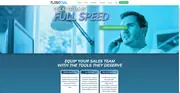
The main product was TurboDial, an SMS and voice automation platform for sales teams. The scope of the work was wide. Front-end interfaces for the Angular application that reps used to run their call sequences and SMS workflows. A companion iOS app built with Ionic and published to the App Store, which meant going through the full Apple submission and review process. AI integrations layered on top of the calling workflows, using OpenAI, Gemini, and eventually self-hosted open-source models for clients who needed their data to stay on their own infrastructure.
Each of those pieces required a different skill set and a different kind of attention. The iOS app submission process had its own rules and review criteria that had nothing to do with writing code. The self-hosted LLM setup required understanding deployment and infrastructure in ways that were outside my usual front-end scope. The AI features required thinking carefully about where processing happened, how results were delivered back to the interface without blocking the user, and how to present machine-generated content in a way that actually helped a sales rep do their job faster.
None of that was in the job description from day one. It accumulated over time, driven by the needs of the product and the size of the team. When you are one of three engineers, there is no one else to hand a problem to. You pick it up, you work through it, and you figure out what you need to figure out.
That is the part of Agency Automate that is hard to put into a resume bullet point. The technical skills are real and they are there. But what grew alongside them was something harder to name: a willingness to sit with unfamiliar problems without retreating to what was already comfortable, a sense of responsibility for the whole product and not just the parts that felt safe, and a confidence that came from Rob giving me an opportunity before the credentials fully justified it, and then watching that bet slowly pay off.
Two years is a long time to work closely with a small team. Rob and Markus shaped a lot of how I understand the craft of building software, not through formal instruction but through the day-to-day reality of working on real things together. That kind of environment is not easy to find. I am grateful it was the environment where most of my most important growth happened.